
We install, repair, and replace flat roofs on Santa Monica homes and businesses. Low-slope means a roof that looks flat but sits at a slight pitch. Niv Levy and our team serve homeowners, commercial owners, and property managers.
Have a roof question? Dial (424) 217-3627 and ask us about it directly. You can also fill out the form and request a free estimate.
A call may involve a leak, aging surface, or planned upgrade. We listen, then match work to your roof's needs.
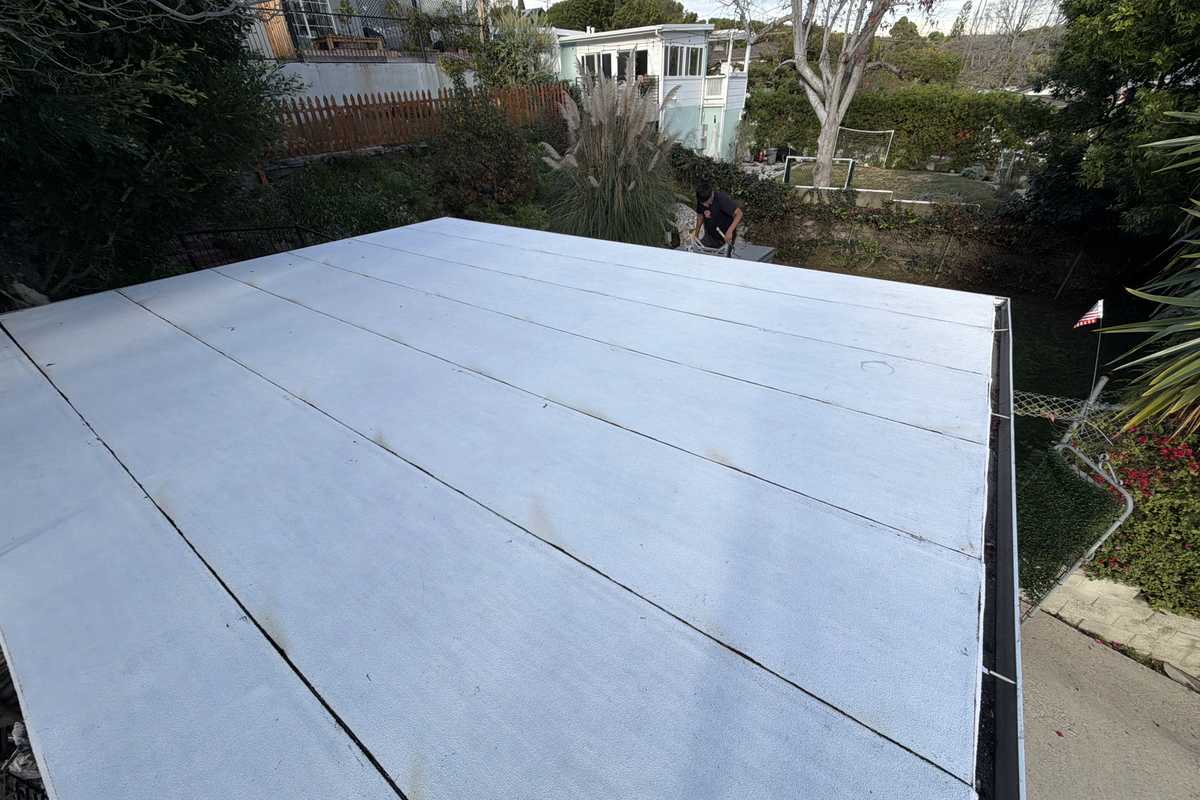
Low-slope roof repair and replacement options
Low-slope roof repair and replacement start from the same question. What shape is the current roof in today? Your answer points us toward the right path.
A membrane is the waterproof sheet or coating that covers the roof deck. Some membranes fail at a few spots only. Others show wear across the entire surface.
Isolated problems often point toward roof repair. Widespread wear, soft insulation, or repeated patching often points toward roof replacement. We can walk you through both options before you choose.
We also handle roofs with mixed conditions. Where that applies, we can outline repairs now and replacement later.
Visible changes at seams or roof edges also help, along with the spots where past patches went. Mention any rooftop equipment work you have planned. These details help us understand your roof, but they don't decide the work.
Flat roof drainage and flashing
Flat roof drainage moves water off the surface and away from the building. A drain is an outlet that carries water through or off the roof. A scupper is an opening in a parapet wall that lets water escape.
Flashing is the metal or membrane material that seals joints, edges, and transitions. A penetration is anything passing through the roof, such as a vent or pipe. These details need careful attention on any low-slope roof.
Tell us what you see and when you first noticed it. That background helps us narrow the review before we get started.
Here are the areas we review on a flat roof:
- Penetrations: vents, pipes, skylight curbs, and equipment supports.
- Flashing and edges: wall bases, parapets, and perimeter metal.
- Scuppers and drains: outlets, strainers, and the surfaces around them.
- Membrane seams: laps, terminations, and earlier patch work.
- Deck and insulation: the layers sitting under the membrane.
We can report what we observe and explain your choices in plain terms. Call (424) 217-3627, or fill out the form below instead.
Torch-Down Modified Bitumen Roofing
Low-slope roofs rely on a continuous membrane instead of overlapping shingles. Modified bitumen belongs to that membrane family.
Modified bitumen is an asphalt-based roofing membrane reinforced with polymers. Manufacturers make it in rolled sheets for low-slope roofs. We install it as a layered system across the deck.
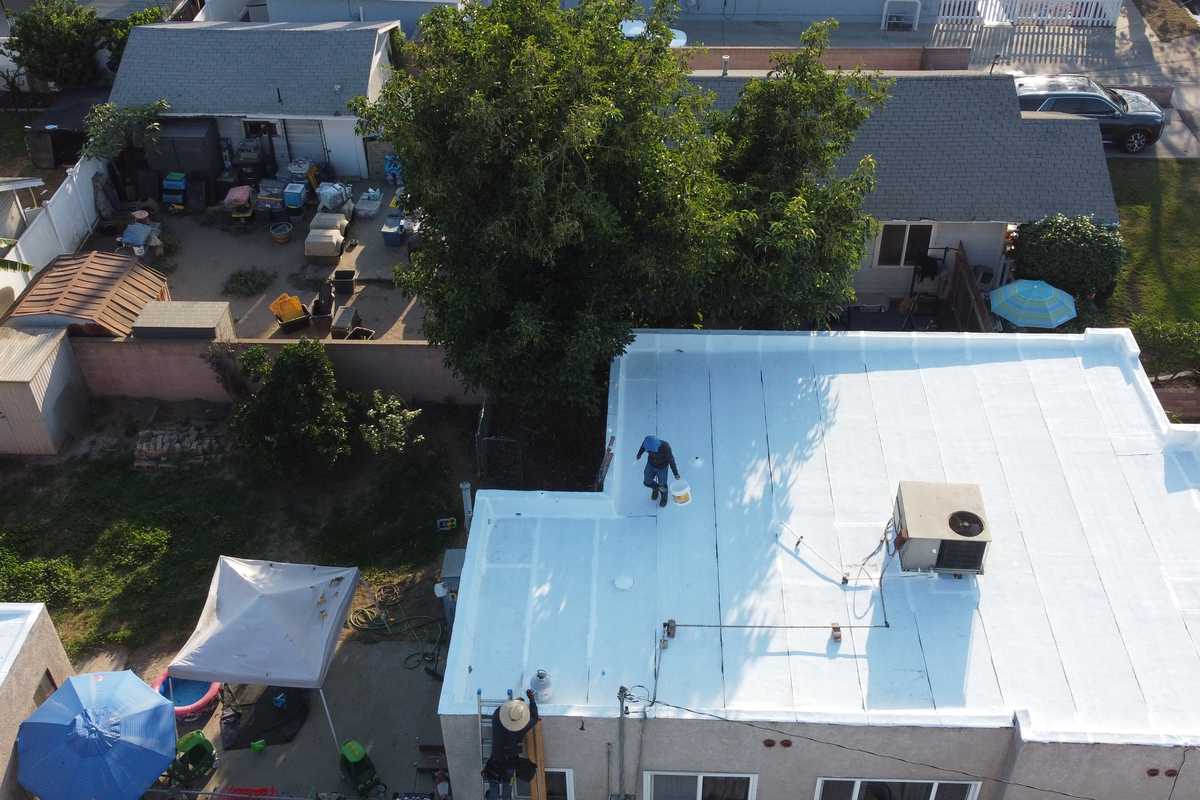
Torch-down describes one way we apply those sheets. The installer uses an open flame torch to melt the sheet's underside. The melted asphalt bonds the sheet to the surface below.
For many low-slope projects, we prefer torch-down modified bitumen roofing. Our crews pick Polyglass Polyfresko G for many low-slope roofing jobs.
Penetrations and edges need detailing that stays compatible with the rest of the assembly. Drains, vents, and curbs all sit within that picture. Project conditions shape how we discuss any system, so we do not name one system for every building.
Comparing Flat Roof Membrane Systems
Flat roof membrane systems fall into a few common families. Each one uses different materials and a different attachment method.
TPO Roofing
TPO stands for thermoplastic polyolefin, a single-ply plastic membrane. Crews roll it out in sheets and heat-weld the seams. Explore our TPO roofing guide for more details.
We offer TPO where it fits the project. It is not our universal answer for every flat roof.
EPDM Roofing
EPDM is a synthetic rubber membrane, also installed as a single ply. Installers join the seams with adhesives or seam tape.
We rarely take on EPDM work. Owners comparing options for larger buildings can start with commercial roofing. We help you compare systems when a low-slope roof needs full replacement.
| System | What it is | Our availability |
|---|---|---|
| Modified bitumen | Polymer-reinforced asphalt sheets, often torch-applied | Preferred for many low-slope projects |
| TPO | Single-ply thermoplastic polyolefin with welded seams | Available where appropriate, not universal |
| EPDM | Single-ply synthetic rubber with adhered or taped seams | Rarely part of our work |
Our recommendation depends on the deck, the slope, and the building's use.
Santa Monica Flat Roofing Service Area and Permits
We install and repair flat roofs in Ocean Park, Sunset Park, and Downtown Santa Monica. Service covers 90401, 90404, and 90405; elsewhere in Santa Monica, call to confirm service.
Santa Monica Roofing Contractors is a division of Home Vision Remodel.
View Home Vision Remodel's CSLB #1112525 record.
When a project calls for permits, we help property owners pull them. The City of Santa Monica decides approvals and inspections. Requirements vary, so review the City's building permit application types page.
Santa Monica's Permit Services Center handles permit services and helps you reach Building and Safety records. Contact the City directly to confirm your flat roof permit needs, since the City decides all approvals.
Santa Monica Roofing Contractors
Santa Monica, CA
Flat Roofing Questions From Santa Monica Owners
Flat and low-slope roofs bring up questions. Below, we answer six of them.
What is the major disadvantage of using a flat roof?
A flat roof has very little slope, so water moves off it slowly. Drainage matters on a low-slope roof. Seams and flashing are the points where the roofing system joins itself or meets walls, curbs, and edges.
Roof condition varies from building to building. Two flat roofs of the same size can be in different shape. That is why we talk about your roof, not flat roofs in general.
Can a flat roof be repaired instead of replaced?
The choice depends on your roof's condition and how far the damage reaches.
We handle both. See more on our roof repair and roof replacement pages. Tell us what you are seeing, and we can talk through which path fits your building.
What flat roof systems do you install?
We prefer modified bitumen for many low-slope projects. Within that category, we prefer Polyglass Polyfresko G for many of these projects.
We offer TPO whenever it suits the project. We use EPDM only occasionally.
What does "low-slope" mean on a flat roof?
A low-slope roof looks flat but has a slight, intentional pitch built into its surface.
That gentle incline directs water toward drains, scuppers, or gutters as the drainage system was designed.
What are drains and scuppers on a flat roof?
A drain is an outlet that carries water through or off the roof.
A scupper is an opening in a parapet that lets water escape.
Do you work on both homes and commercial buildings?
Yes. We work on flat and low-slope roofs for both homes and commercial buildings. Flat and low-slope roofing is part of our work on each.
You can read more about our residential roofing and our commercial roofing services. Tell us which one describes your building.
Call for a Free Flat Roofing Estimate
Give us a call to talk through your flat roof, or send us your details using the form below. Niv Levy and the team will review your request with you.
Tell us what your roof is doing and where the issue shows up. That gives us a clear starting point.